 The Wallet Shoppe
Ekster and Secrid both solve the same annoyance — fishing through a stack of cards to find the one you need — by fanning cards out from a metal holder. Ekster’s Parliament uses a push-button; Secrid’s Slimwallet uses a lever. Both add leather pockets and cash storage around the mechanism, and either can carry a separately bought tracker if you leave room for it.
The Ekster Parliament
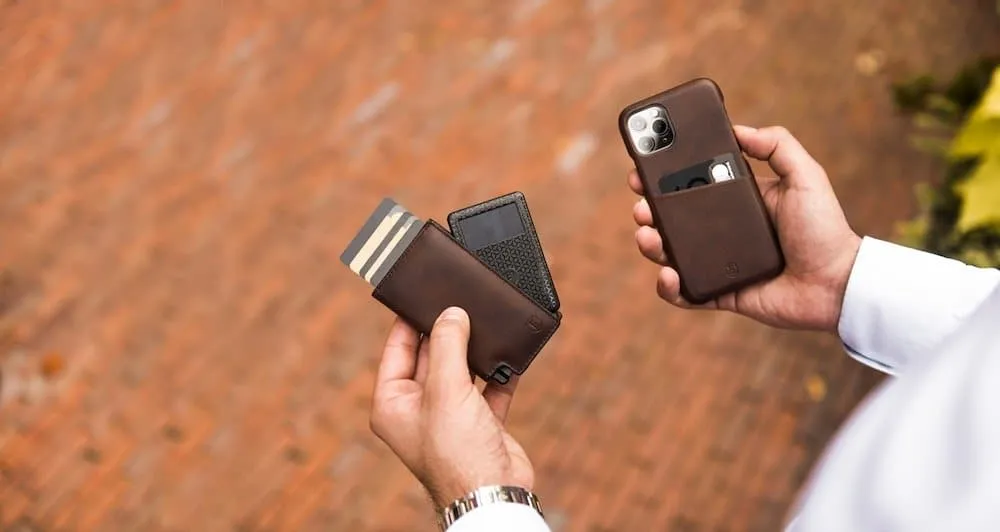
Push the button and the cards stair-step out. The Parliament wraps that ejector in full-grain leather, with extra pockets and a strap for folded bills. The standard wallet manual recommends up to four embossed or six flat cards in the mechanism, with additional storage outside it.
The Parliament name refers to the older model linked here. Ekster now uses Ekster Wallet for its standard leather design and also sells a separate Wallet Pro. Specifications and accessories vary by generation. Our full Ekster review covers the leather and aluminum approaches.
We like the flush button for quick access. Keep the extra pockets lightly loaded if the slim shape is what attracted you: cards, cash, and a tracker all add thickness.
The Secrid Slimwallet
Secrid’s core idea is the Cardprotector: an aluminum shell whose lever fans the cards out in a cascade. The Slimwallet holds up to four embossed or six flat plastic cards in that holder, plus up to six extra cards in the leather wrap. Twelve is the whole-wallet maximum with flat cards, not twelve cards in the ejector.
The Slimwallet’s wider leather wrap has room for banknotes and receipts, and closes without a snap. The aluminum holder protects the cards inside it from unwanted RFID communication; don’t assume the outer leather pockets offer the same shielding. Our full Secrid review covers the Slimwallet and other layouts.
Choose it if you like the lever action and open leather wrap. It has no built-in tracker, but a suitable thin tracker can go in the outer storage if the rest of your load leaves room.
Mechanism: Button vs. Lever
Both mechanisms present a staggered stack of cards. Ekster uses a button at the lower corner; Secrid uses a lever at the base. Neither wallet needs a battery for card ejection.
The practical difference is the control you prefer, not a guarantee that a lever outlasts a button. Try the mechanism with the cards you use, especially if some are embossed or unusually thick. Don’t force more cards into either holder than the maker recommends.
Capacity & Cash
The Parliament’s additional pockets and cash strap sit outside its ejector. Ekster’s standard-wallet manual lists a total of 1–12 cards and recommends nine; the current store page advertises a different total for the newer Ekster Wallet, so check the version before comparing maximum loads.
The Slimwallet also has genuine cash storage: the leather wrap and billfold hold banknotes, with up to six extra cards outside the Cardprotector. It doesn’t need a second purchase to carry cash. Choose Ekster if you prefer bills under a strap, or Secrid if you prefer its billfold insert. Neither will stay at its empty thickness when packed with cards and cash.
Smart Features & Tracking
Ekster makes its own tracker card, bought separately from the wallet unless a bundle includes it. The current Tracker Card recharges wirelessly and pairs with Apple Find My or Google Find Hub. The older solar card used different hardware and an app; solar charging doesn’t describe the current card.
Secrid’s Slimwallet can carry a suitably thin tracker in its outer leather storage too. Keep it out of the card-ejection mechanism and check the loaded fit. Ekster’s branded accessory is convenient, but a findable wallet isn’t exclusive to Ekster; see our best wallet trackers for the card options.
Reliability & Warranty
Both wallets have moving parts that can jam or wear. Secrid’s support guidance describes repairable felt pads, its Salamander lever mechanism, and Care & Repair locations. That accessible repair support is why we’d give Secrid the edge in this category.
The standard Slimwallet has a two-year warranty, extended to three after registration. Ekster’s limited warranty describes 24-month coverage for manufacturing defects; lifetime terms are offered for some newer products or programs. Match the policy to your model and purchase rather than assuming every Parliament has the newer Pro warranty.
Owner CupcakeOk5838 reports an Ekster mechanism failure after about a year in this discussion of pop-up wallet longevity. Secrid owner sparky750 says theirs still worked well after six years of daily use. Repair access and the terms of the warranty matter alongside the control you prefer.
FAQ
Which ejector mechanism is more reliable long-term?
For ownership support, we’d choose Secrid because it offers Care & Repair locations and guidance for its mechanism and card-retention pads. A lever alone doesn’t establish a longer service life than Ekster’s button.
Which one is better for someone who carries cash regularly?
Both carry cash. The Parliament uses folded-bill storage under a strap; the Slimwallet uses its leather wrap and billfold insert. Pick the layout you prefer, and compare them with your usual cash and card load.
Does Secrid make a version with tracking?
The Slimwallet has no built-in tracker. You can add a thin tracker to its outer storage if it fits, just as you add a separately bought tracker to a Parliament.
If style matters as much as mechanism, our Bellroy vs. Ekster comparison covers the leather-traditionalist alternative to Ekster’s smart-wallet approach, and Ridge vs. Secrid covers how Secrid’s ejector stacks up against Ridge’s elastic-band design.